Habakkuk Series- Pt. 4

Photo by Joshua Earle on Unsplash
Read Time: 5 minutes
by AJ Canterbury
What a journey it has been as we’ve lingered in the Old Testament book of Habakkuk. We have discovered that the book has much to say when life gets too hard to understand. Habakkuk continues to teach me about trusting God.
The prophet has endured quite the journey too. The book opened with his complaint about the evil around him. When God answers him, the revelation about what God plans to do leaves Habakkuk with more questions.
As God reveals the fullness of his plan for Babylon and Judah, Habakkuk is humbled by the complexities of God, amazed by his strength, wisdom, and his faithfulness to his people. His encounter with God changes his perspective.
The central message of the book rests in one of its verses, serving as a lynchpin that binds the prophecy together. “… The righteous shall live by his faith” Hab. 2:4. The verse captures Habakkuk’s journey and how he walks forward in confidence, even while the oppression of Babylon casts its long shadow over Judah.
But what exactly does it look like for the righteous to live by faith?
I long to live by faith, as I think any Christian would. But in the face of so much doubt, disappointment, and discouragement, it feels I am more often overwhelmed by despair than liberated by faith. How can living by faith stand up against all that pulls us away?
And living by faith seems an ambiguous description, more of a pat Christian answer of what we should do. Is there anything more concrete that can show me how to live like that?
The prophet’s prayer, in chapter three, offers answers to these questions. And Habakkuk, whose name means embrace, gives us a living example of what it looks like to live by faith.
Helpful Insights from Habakkuk’s Hymn
In the book’s closing chapter, Habakkuk composes a prayer and sends it to the minstrel to be set it to music. I think Habakkuk had every intention for his hymn to be sung in worship while Judah suffered under their Babylonian captivity. The words would offer hope to them in midst of turmoil.
- Remember
Habakkuk is preparing his people by giving them this hymn. His words open the path for God’s faithfulness to conquer the faithlessness of the people.
He opens with a catalogue of how God has acted with strength and faithfulnss toward Israel in the past. Habakkuk alludes to the meeting with Abraham, the dramatic rescue at the Red Sea, and the giving of the law on the holy mountain. Important reminders that God has not failed to intervene and deliver before.
How the people of Judah would have needed to recall the faithfulness of God while living under the control of a wicked captor. How great their need to know their God had promised their deliverance, and the past had shown that he could be counted on to do it.
If Judah could sing of his faithfulness, perhaps hope would be kindled.
This kind of reminder is powerful. Judah had to hear it because I know I need it. Daily.
My progressive disease can overtake my mind and form a cloud of spiritual amnesia. Here, I cannot remember God ever coming through for me, and I’m convinced he will abandon me. The only way to combat the lie is to be prepared to counter with the many ways God has provided for me.
Habakkuk is preparing his people by giving them this hymn. His words open the path for God’s faithfulness to conquer the faithlessness of the people.
- Cling
Living by faith looks like embracing the promises of God and holding fast to them even when all seems hopeless.
They will need the reminders of the past to cling to when there is no sign of redemption in their present. Until God chooses to act, Judah will need to wait patiently for him. And there is nothing easy about waiting patiently for God to arrive.
Habakkuk describes their current situation this way: “Though the fig tree should not blossom, nor fruit be on the vines, the produce of the olive fail, and the fields yield no food, the flock be cut off from the fold and there be no herd in the stalls,” (Hab. 3:17).
The future of Judah looks bleak. Not only is there no fig or fruit to be found, but there is no sign that any is promised for the future. No blossom or flowers show new growth; the livestock has dwindled and the stalls are empty. Things are going to stay hard for Judah.
I was warned early on that the Friedreich’s Ataxia would chip away at my ability to do things independently, but it was still a shocking betrayal when it started to happen. The things I had once been able to struggle through, like traveling alone, now became impossibilities.
As time goes on, I see more freedoms that have been eliminated by the disability, and it sobers me when I consider the future. Unless God grants a miraculous intervention, the disease will continue to rob me of more. It seems I’m staring into a future that holds only loss and disappointment.
I can resonate with Habakkuk’s sentiment: “there is nothing now and it’s not coming in the immediate future.” Somehow Judah’s desolation today looked even darker tomorrow. I can relate.
How can any of us expect to hold on to him then?
Habakkuk continues with this, “yet I will rejoice in the Lord; I will take joy in the God of my salvation” (Hab. 3:18).
Even before there is a glimmer of him on the horizon, Habakkuk will cling to God’s promise. The prophet tells Judah to not give up on the Lord for he will come through just as he has said. Take joy in the thought of your salvation, even when it hasn’t happened yet.
This is what living by faith looks like. It is embracing the promises of God and holding fast to them even when all seems hopeless. Because his promises are firmly established unlike your circumstances.
Your faith is based on your firm confidence in what you believe, assurance that it is more than just mere belief. You live each day with the expectation that at any moment God will deliver on what he has promised.
When I feel devastated by physical inability, I remember that this world is but a passing shadow. It does not hold the final say. He is returning for me and when he does, he will usher in renewal and will eternally free me from the disease.
Give Me Feet Like the Deer
Trust his promises. Trust his character and his purposes. Trust him.
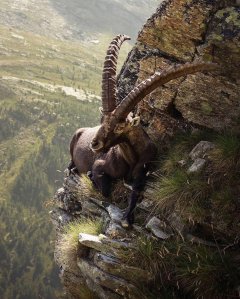
When I hold onto that and live like today is the day of my salvation, I discover Habakkuk’s final words to be true. “God, the Lord, is my strength; he makes my feet like the deer’s; he makes me tread on my high places” (Hab. 3:19).
The hoofed feet of the deer or mountain goat scale the highest, most dangerous ledges with ease. With sure-footedness, the deer climbs impossible cliffs because its back feet step exactly where their front feet have just been. They don’t have to fear that their feet will find a ledge to hold them.
Having hind feet like the deer is the result of living by faith. I don’t have to know what awaits me in the future; I let his words, and only his words, guide me. They won’t let me down.
A confident belief like that is not easily accomplished. I find myself needing to fight for it often. “Trust” has become a calming mantra for me. When anxiety and frustration seize me, I catch myself muttering this, sometimes through clenched eyes and teeth.
“Trust.”
Trust his promises. Trust his character and his purposes. Trust him.
Usually, my mind counters with “But…,” like “but you’ve already seen so much taken away from you” or “but tomorrow you will still wake up with the disease.” All these things may be true, but I refuse to dwell there.
Even when, the disease seems to be winning, and even now, when the disease is determined to stay, I choose to trust his promise of salvation. Eventually my mind quiets and I surrender to his call to climb higher.
If you would like to get my free devotional, “Faith From The Chair,” please sign-up below:


 AJ Canterbury
Leave a reply to AJ Canterbury Cancel reply